
Factorio: Space Age
A Sequel in the Form of an Expansion

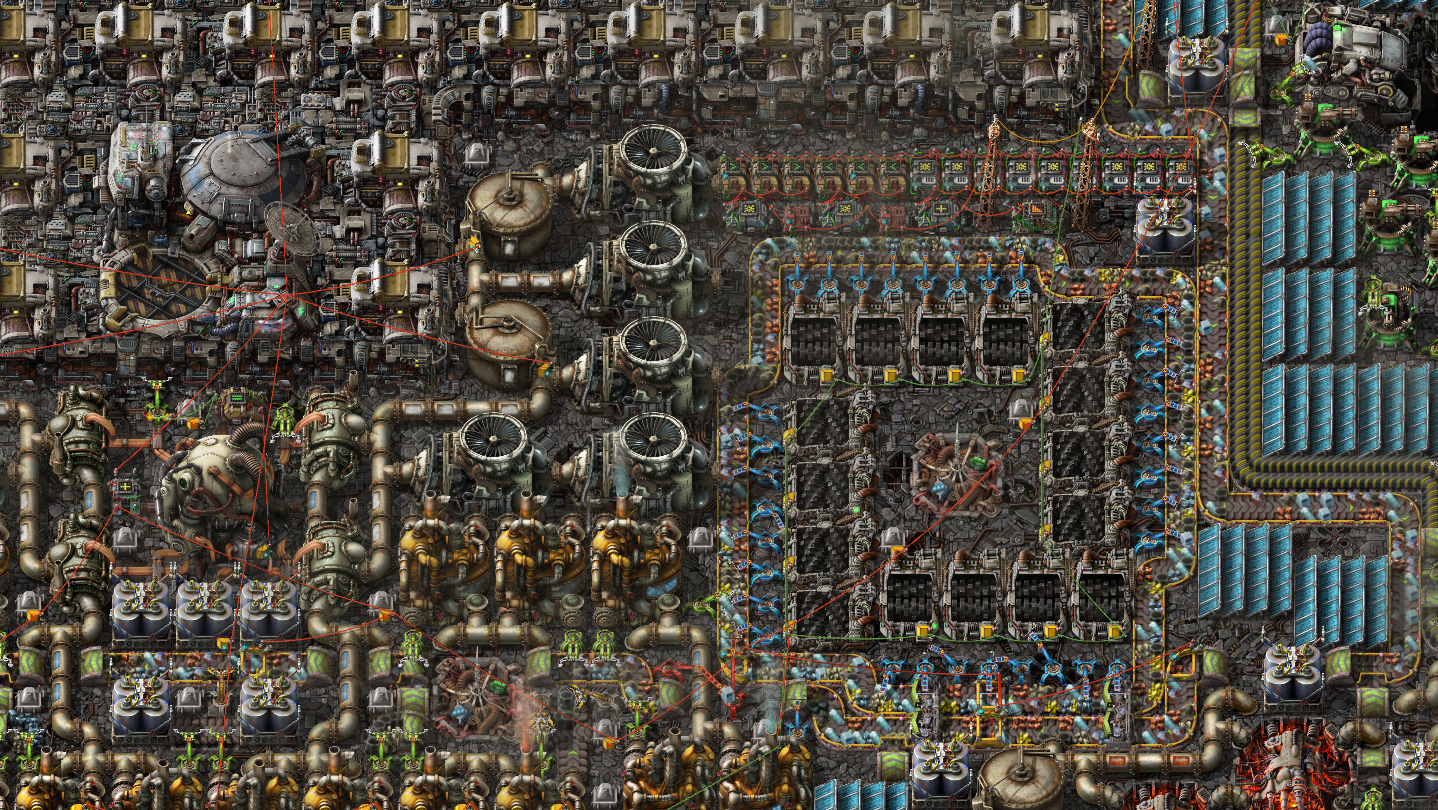
Game Information
Game Name: Factorio: Space Age
Platform(s): PC
Developer(s): Wube Software
Publisher(s): Wube Software
Genres: Automation, Simulation, RTS, Building
First Release Date: Oct 21, 2024
Last Major Update Date: N/A
Description: Factorio: Space Age continues the player's journey after launching rockets into space. Discover new worlds with unique challenges, exploit their novel resources for advanced technological gains, and manage your fleet of interplanetary space platforms.
Reviewed On
Hardware: S.T.A.L.K.E.R.
(Radeon RX 6950 XT, AMD Ryzen 7 5800X3D, 32 GB RAM)
Platform: Steam
Review Notes
Introduction
If you read my previous article on Factorio, you would know the promotional material for Space Age is what motivated me to learn Factorio in the first place. So, last year, I buckled down and immersed myself in just the base game. My first playthrough took me from September all the way through February. I learned the ins and outs of the base game, really enjoying the progression, loving the ways to automate processes, and of course dedicating a lot of time to trains, because trains are cool. I came away from the six-month playthrough feeling like I had just found a perfect game. I really had no complaints, no bugs to report. All in all it felt like a very complete package. And then I remembered Space Age existed. Before diving back in, I decided to take an intermission and play some other games to refresh and cleanse the palate. But in due time I returned, ready to go, ready to explore space.
 Sevastromo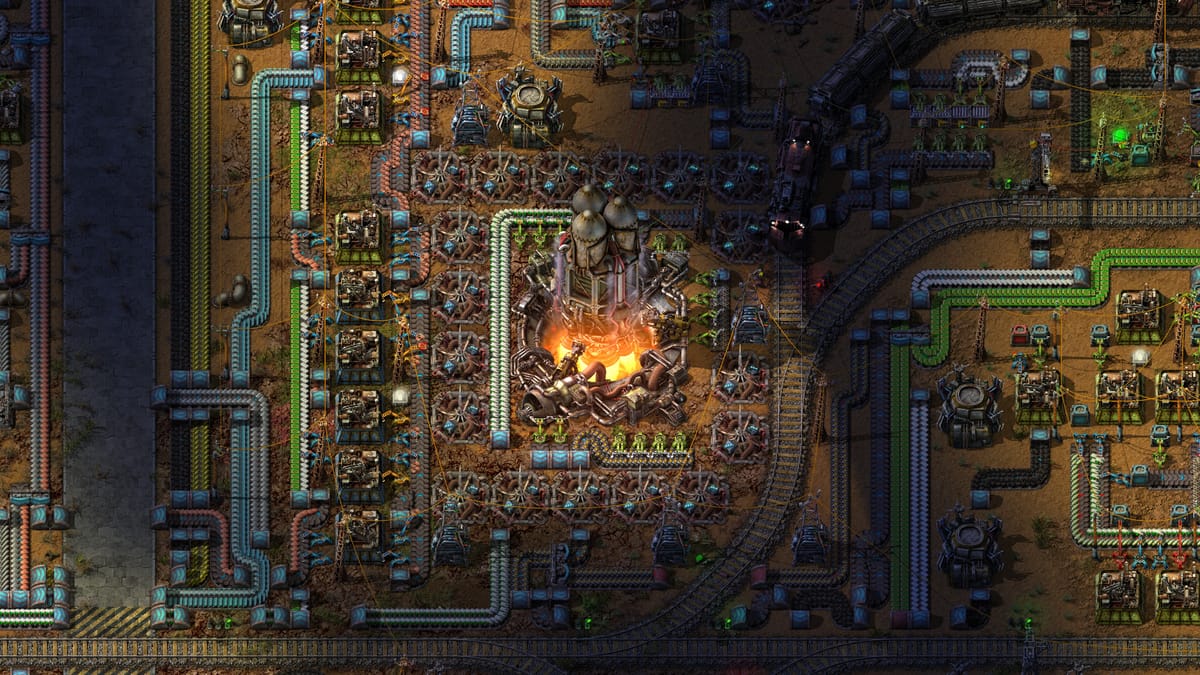
The Run Back
So, before we get to the juicy, new Space Age stuff, we do have to play the game all over again. Initially, I was a little frustrated/intimidated. I had previously spent ~300 hrs building this glorious factory and I wasn't able to repurpose it for Space Age. Also, I would have to do all that stuff over again, which wasn't looking like a small commitment. But it only took mere minutes of being back in the saddle, back at square one, to realize this wasn't going to take 300 hrs again.
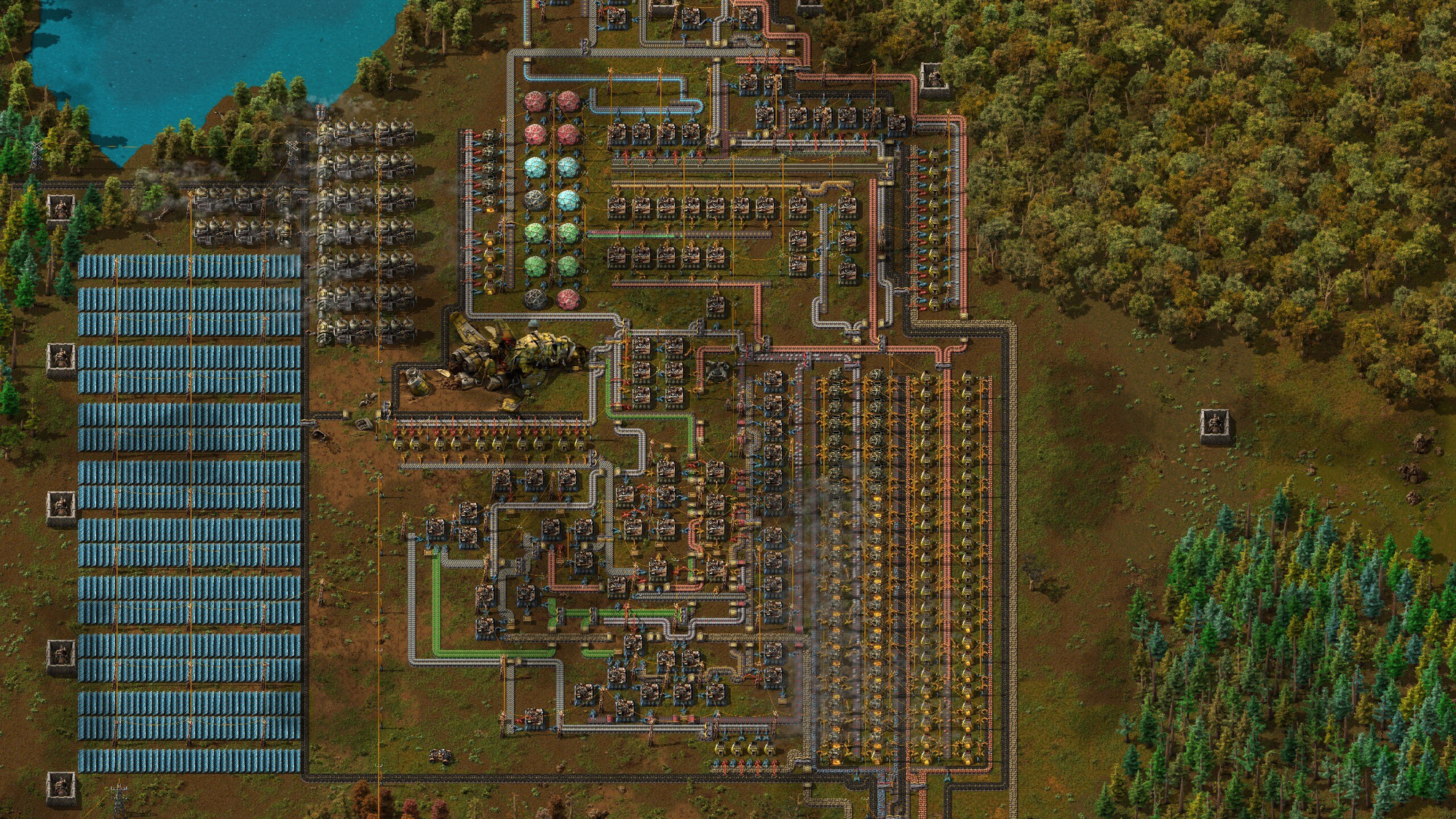
What changed the game for me first and foremost this time around was that I understood what belt throughput rates were, knew how to see machine input and output rates, and most importantly had the Rate Calculator mod to smooth over the math of it all. My first goal was to get red, green, black, and blue sciences up to 30 science per minute. With these sciences chugging along I could research all the early game technologies and setup assemblers to supply all the infrastructure I'd need to build the mid-game factory.
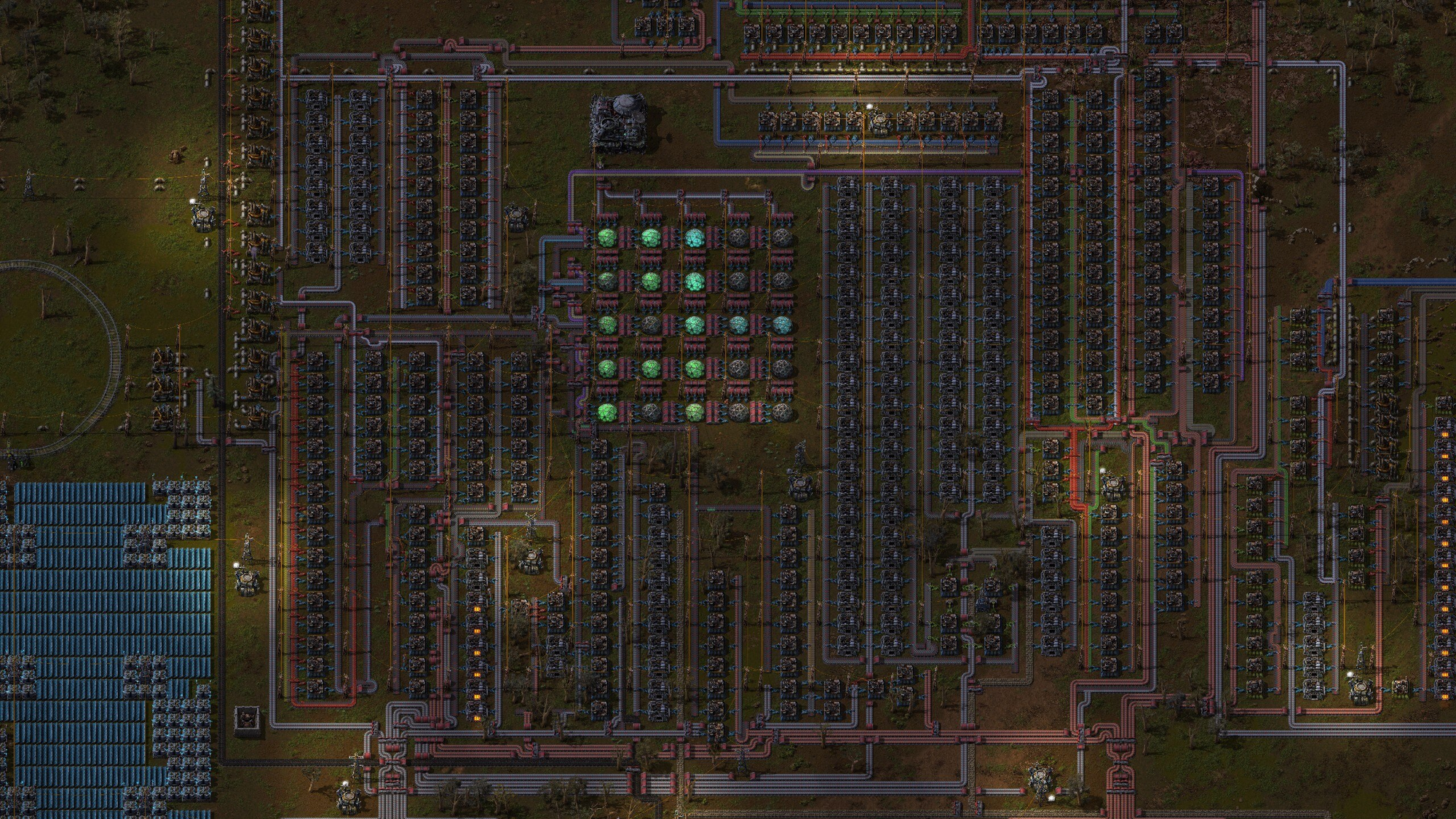
For this mid-game factory, I planned on hitting a consistent 60 spm. This target would carry over to all of my initial factories on the Space Age planets as I thought it was a nice round number that was both modest in scope yet still effective at getting us through the research tree. At the end of the day, this time around, Nauvis took around 50 hrs all things considered. The progression was adjusted for Space Age, meaning some nice-to-have items like cliff explosives, artillery, and spidertrons are locked away on other planets for now. But, at the same time, rockets are much cheaper, meaning you don't need to do quite as much to start launching things into space. I was fairly thorough in my Nauvis setup making sure we had a sustained, smooth 60 spm for the foreseeable future. Check out the video below for a tour of my Nauvis factory pre-Space Age content. I really enjoyed going through this part of the game again, this time in a more competent fashion.
What is Space Age?
The end goal of this article is to once again showcase a "Factory Tour" style YouTube video, just this time it will be multi-planet and maybe multi-video. But first I want to run through all the new stuff Space Age adds and give some brief thoughts on how it fits into the Factorio formula.
Space Age picks up where Factorio left off: with the rocket launch. But this time you have to launch with a Space Platform Starter Kit to keep progressing. This is because the technology tree starts to require space science and it is no longer sufficient to simply launch a rocket to get those white beakers back. With Space Age, space science must be manufactured on a space platform.
Space Platforms
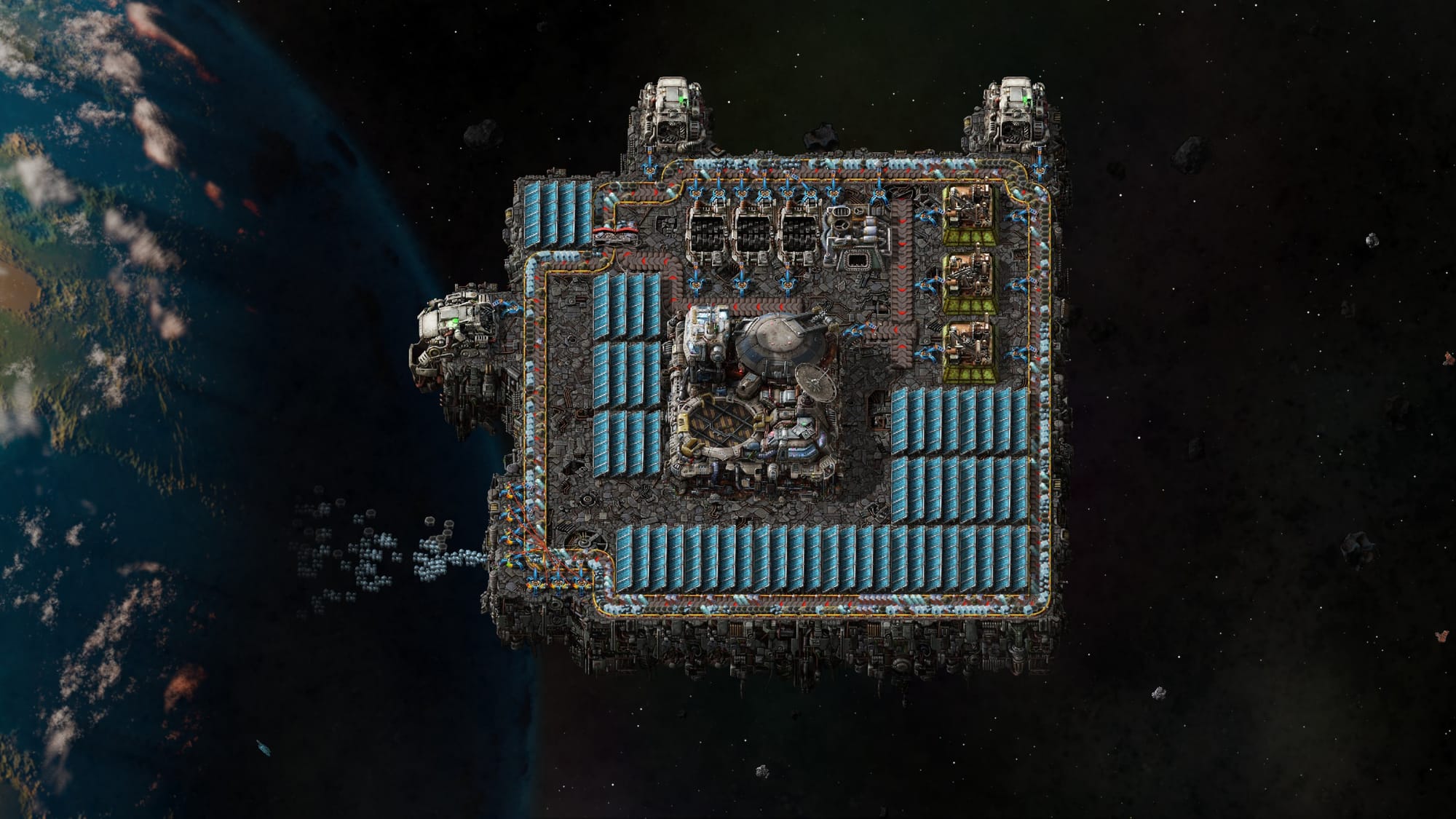
Space Age fundamentally alters the base Factorio experience by changing how resources are acquired and how items are manufactured. In the base game base resource acquisition was fairly straightforward. There's a patch of iron ore, you place a miner down, it mines the resource, and you get the item called iron ore. When you drilled for crude oil, you were able to pump out crude oil. Seems simple, and it was. Things got complicated after that point in the base game. In Space Age with space platforms, this is the first time you'll be confronted with "mining" or harvesting base resources of an unknown type and quantity. In space, asteroids are your base resource, there's three types: metallic, carbonic, and oxide, and the asteroid collector is the only method to collect all three. All three of those asteroid types are required for the space science recipe and this is where a fundamental change in Factorio gameplay occurs. Suddenly your process has waste. The ratio between the three asteroid types you harvest is not directly proportional to the ratio required in the space science recipe. The recipe is really straight forward: 1 Carbon + 1 Ice + 2 Iron Plates = 5 Space Science Packs. The complication comes in when you start to look at the asteroid spawn rates and the asteroid processing recipes.
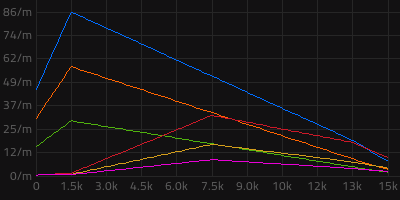
It actually took me a little while to even find these spawn rates, they are tucked away in the Factoriopedia under the space route. But when you do find it and click on one, you get the chart I'm showing below. When you have a stationary platform, you just care about the one side of the graph. So for this Nauvis to Vulcanus route, you just look at the left side and here you can see metallic asteroids are four times more common than oxide asteroids. This difference is then exacerbated by the processing recipes where one metallic asteroid turns into twenty iron plates, while one oxide asteroid turns into five ice chunks. So, if you were simply to process every asteroid as it came in while in Nauvis orbit, you'd end up with eighty iron plates for every five ice chunks, that's far from the 2:1 ratio in the space science recipe.
So, how do we deal with this? Your first reaction might be to simply not care. In base Factorio it didn't matter if you had twenty iron mines and only four copper mines, as long as you saturated the belts leading to the items you were trying to produce, it didn't matter. But remember, the asteroid collectors harvest all of the different resources for us at once. If you saturate the line with metallic asteroids, there will be no room for the less common oxide asteroids to be harvested. Now there's a million ways to get around this problem, but hey, it's a new problem.
The way I look at creating your first space science-oriented space platform is that it's a built-in tutorial to teach you about two big gameplay themes of this expansion: byproducts and perpetual motion. The first test of those principles is when you have to build your first space ship, otherwise known as a moving space station.
Vulcanus
Blazing volcanic mountains, imposing geological landforms, plains blanketed in ash, and thick yellow sulfuric fog that burns your lungs and etches your eyes.
The lava planet Vulcanus was our first stop in space. This planet emphasizes two changes Space Age brings about, one I already mentioned, byproducts, and the other is alternate recipes. Vulcanus switches up a lot of what you're used to on Nauvis by having lava as the base resource for both iron and copper. This time these essential resources are molten and have stone as a byproduct. Vulcanus, similar to the space platforms, teaches you that sometimes you have to throw away something to get what you really want. In this case it's a lot of molten iron and copper, and there's no world where you need this much stone. Luckily Vulcanus provides an easy out for the excess byproduct, as dumping stuff back into lava proves to be an efficient trash can.
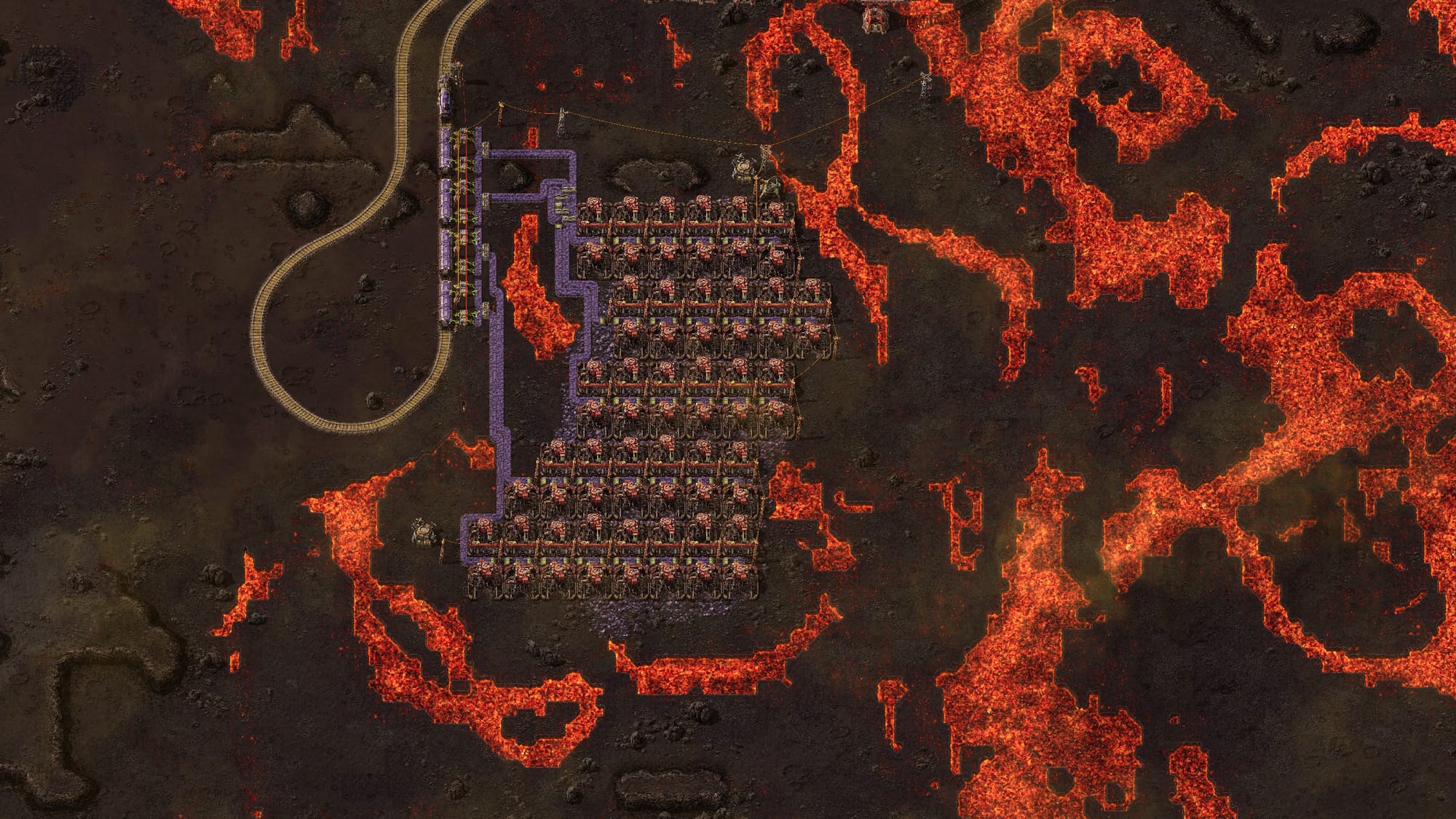
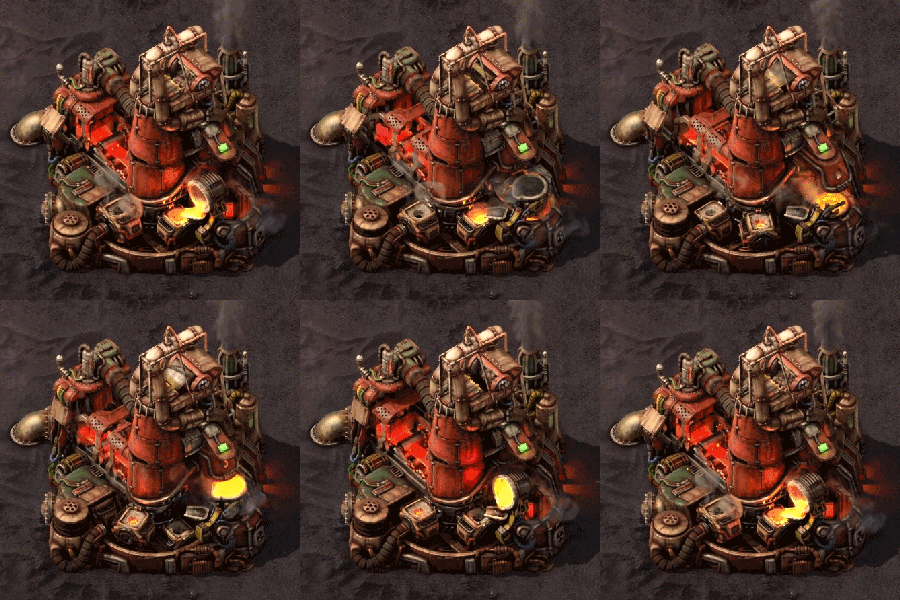
These molten forms of iron and copper are manufactured in a new building, the Foundry, which opens up a bunch of new, alternative recipes that can shortcut some of the tedium found on Nauvis. For instance, steel can be cast straight from molten iron, no need to make plates first. The same goes for pipes and gears so these new Foundries are pretty sweet.
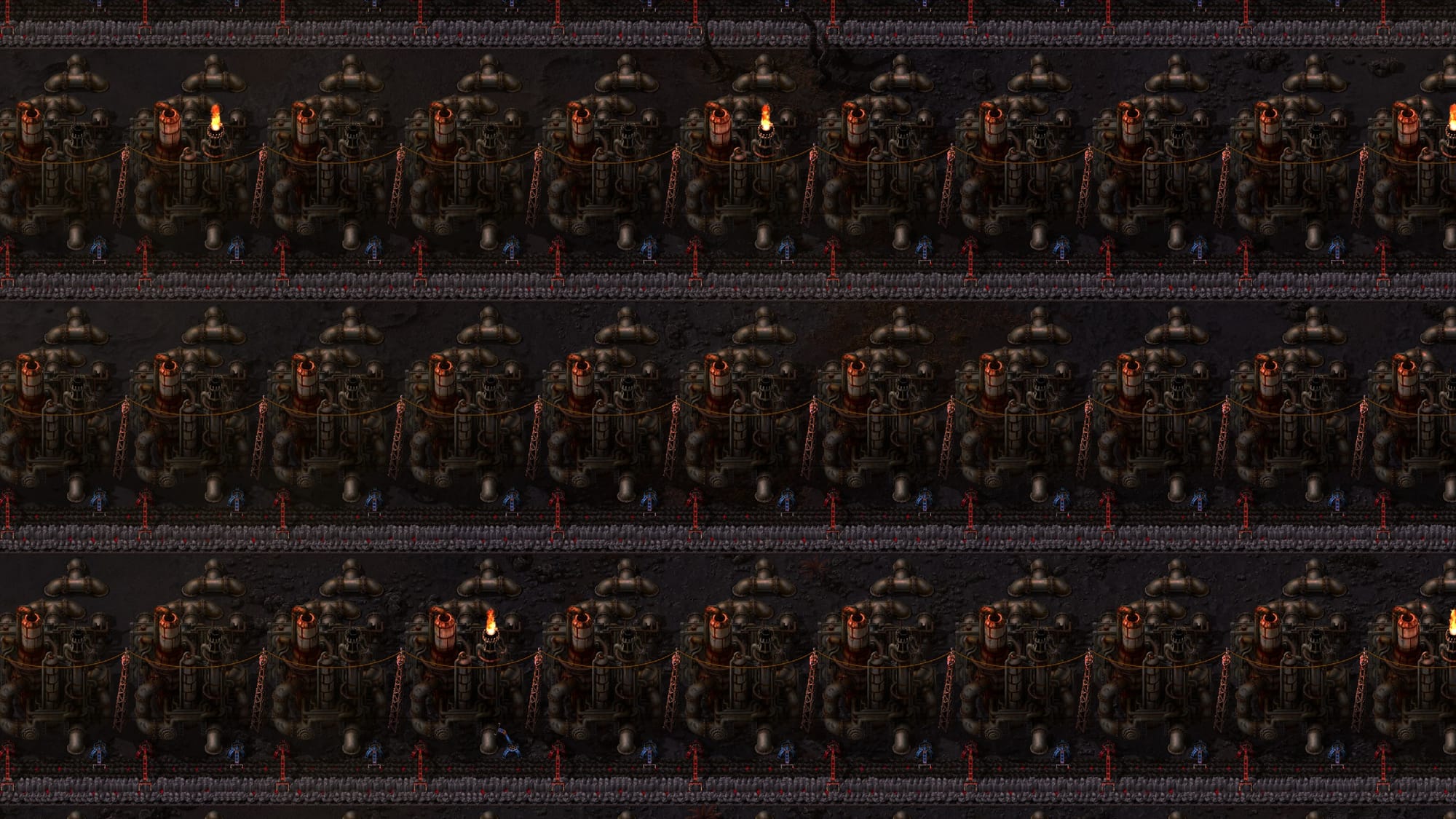
What used to be an often unused recipe, coal liquefaction, is now a necessity on Vulcanus. Crude oil does not exist on this planet, but large amounts of coal sure do. On the other hand, sulfuric acid, which once had to be manufactured, now can be pumped from the ground. Two new resources, calcite and tungsten, are introduced as well. Calcite is necessary for all molten metal recipes while tungsten is needed for all the new crafts Vulcanus can supply. Tungsten plates, tungsten carbide all get used up in critical stuff like the level 3 transport belts, the bigger and better mining drills, and most importantly metallurgical science.
Overall, if space platforms were the nice, little intro to a different way of building a production line, Vulcanus asks if you can scale that new way up to the level of Nauvis. My goal was to match Nauvis' science output, so I needed to be sending over 60 spm. But since it would be via space platforms, the batches would need to be much larger lest I had dozens of platforms running back and forth. The space platforms scheduling is very similar to trains. Planets act as stations and pretty much all the same stop conditions exist to make sure your factory stays in sync and fed. I didn't have a great platform manufacturing pipeline yet on Nauvis, so I wanted to make do with one platform taking care of all Vulcanus to Nauvis needs. The round trip is on the order of ten minutes with the speeds I was hitting, so sending over 2,000 science at a time was more than enough to keep the Nauvis labs happy.
Fulgora
A lifeless and desolate place. The thin air is freezing cold but bone dry. A distant sun twinkles in the dull purple of the sky. Wispy clouds race by as a gale whips up sand that grates against your armor.
Vulcanus was certainly different from Nauvis, but it still felt like base game Factorio. Some of the resources were new, how you got them was sometimes different, but at the end of the day the feel of my Vulcanus factory was like a Nauvis factory on a different planet. Fulgora on the other hand is a whole other beast, we are not on Nauvis anymore. The two concepts that are emphasized on Fulgora are: working backwards and overflow, let's start with working backwards. There are two resources on Fulgora, well kind of three: scrap, heavy oil, and lightning. The easy one here is lightning, that's your power. Setup lightning rods and capacitors and you're good to go.
Heavy oil is easy too, setup a pump and now you are only limited by how much water you can produce. You'll need it for cracking the heavy oil down into light and crude oil. The tricky part is the scrap, it's a single, mineable resource that when processed in a recycler has a percentage chance to breakdown into a variety of items. The quality and value of the items vary with the percentage chance, so a common, easily craftable item like gears have a 20% chance, while the typically more resource-demanding low density structures has a 1% chance. Regardless, the end result of recycling scrap is a randomized belt of mixed resources that you have to sort through.
My first attempt at a small, Fulgora factory was ill-fated. Intimidated by the prospect of sorting through the scrap output I opted to shove everything into active provider chests and left logistic bots to do the sorting. This worked for some time, but then my storage buffers reached a critical mass and upon investigation I realized all my active provider chests and my storage chests were full of gears, solid fuel, and stone bricks. My production lines were stalling out because there was no holmium ore, LDS, blue circuits anywhere and the recyclers were choked out because they had nowhere to output. It was a mess and because I had picked a small island, there wasn't a lot of room for modification. I tried to add some recycler loops to break down the items I was overproducing, but it wasn't enough, my factory was suffocating in the sheer amount of scrap byproducts.
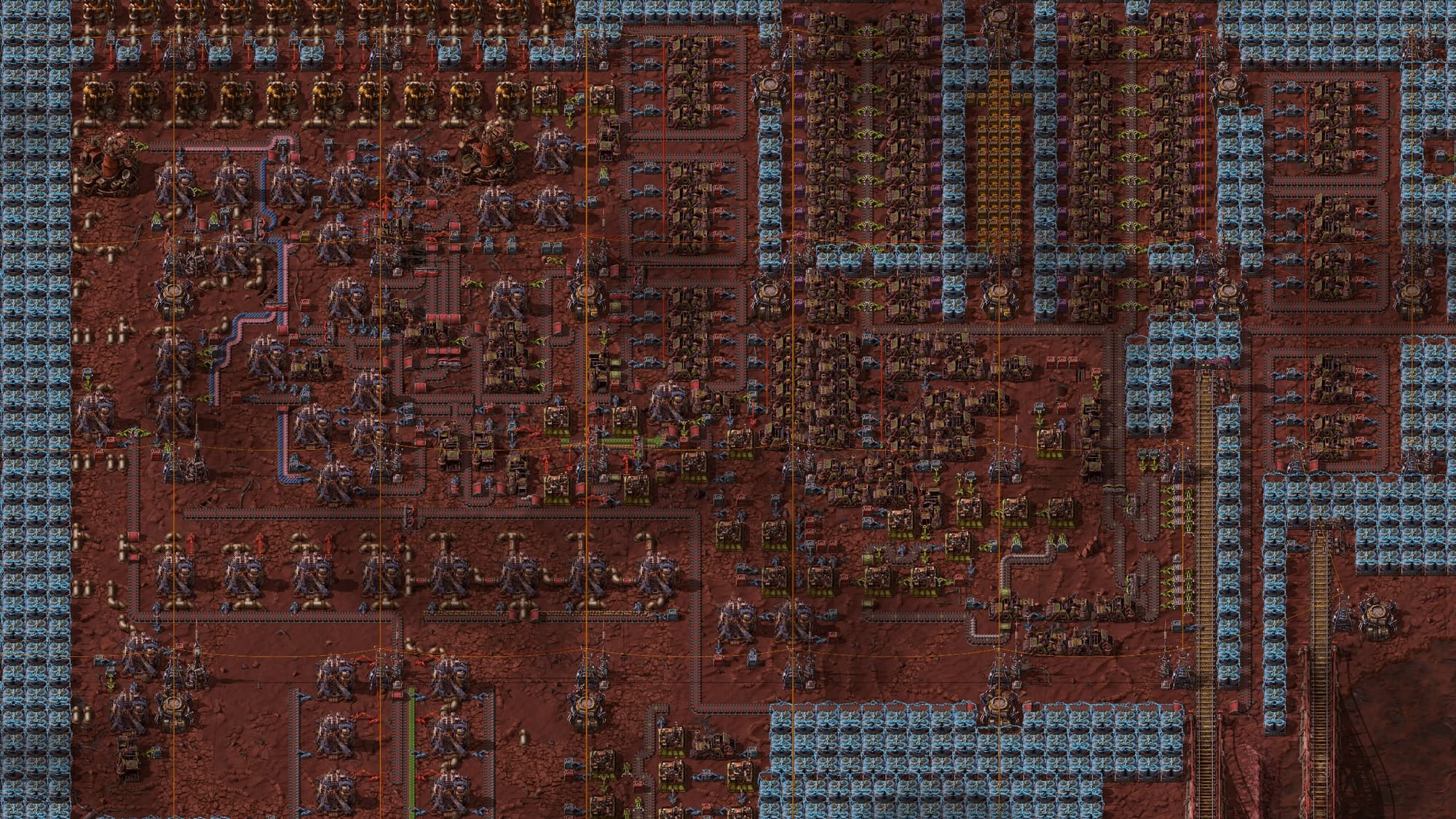
That all was happening while I was trying to figure out Gleba, so before I moved onto Aquilo I knew I had to go back to Fulgora and fix what was clearly broken. For my return to Fulgora I knew I had to start from scratch, there was no reworking my busted bot-based factory. So, my first step was to find a suitably large island where space wasn't such a constraint. I also wanted an adjacent island that was close enough so that a power pole could span the gap, meaning all my power storage in the form of capacitors could be out of the way of the main factory. I also setup a few mines with a small train network to keep me flush with glorious scrap. Once I had this all sorted, I began on the actual build. I had overlooked a key lesson in the first attempt and that was dealing with resource overflow. The outgoing demands of the factory are going to be variable so if you can't control precisely what comes into the factory as a raw resource something between those two steps needs to sort out the junk.
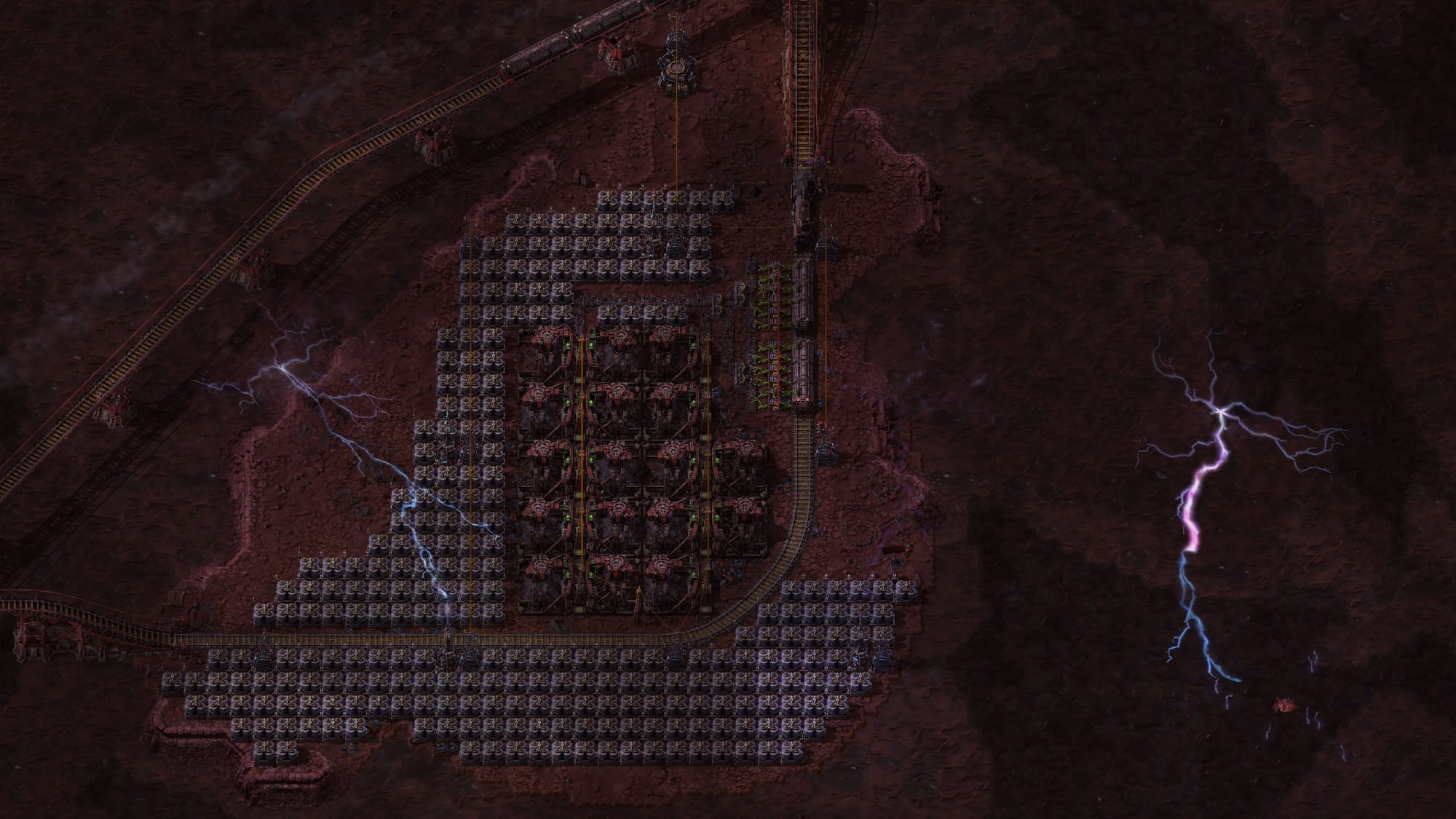
What I came up with is a big resource sorter with overflow, recycler loops for each resource type. Splitters that filter for a specific resource and then splitters with single-sided priority outputs are what do the heavy lifting. This takes the randomized mess of a belt coming off the recyclers and turns it into sorted lanes filled with each resource needed for the rest of the process. When the belts back up to those priority output splitters, the other side takes the excess away to more recyclers to be broken down further and eventually threaded back into that main array of filter splitters. This setup needed a bit of tuning, I started out with only a few scrap recyclers online to figure it out but that scaled up once I saw things running smoothly. Overall though, this was infinitely more satisfying to build and then watch work when compared with the bot build from earlier. While bots are very cool in their own right, getting away from belt-based factories results in Factorio losing something that makes it great. Belts serve as this really nice visual indicator of the status of your production lines, some parts should be moving, other parts need to be jammed full. Without that visual feedback, the game loses a bit of charm and readability in my opinion.
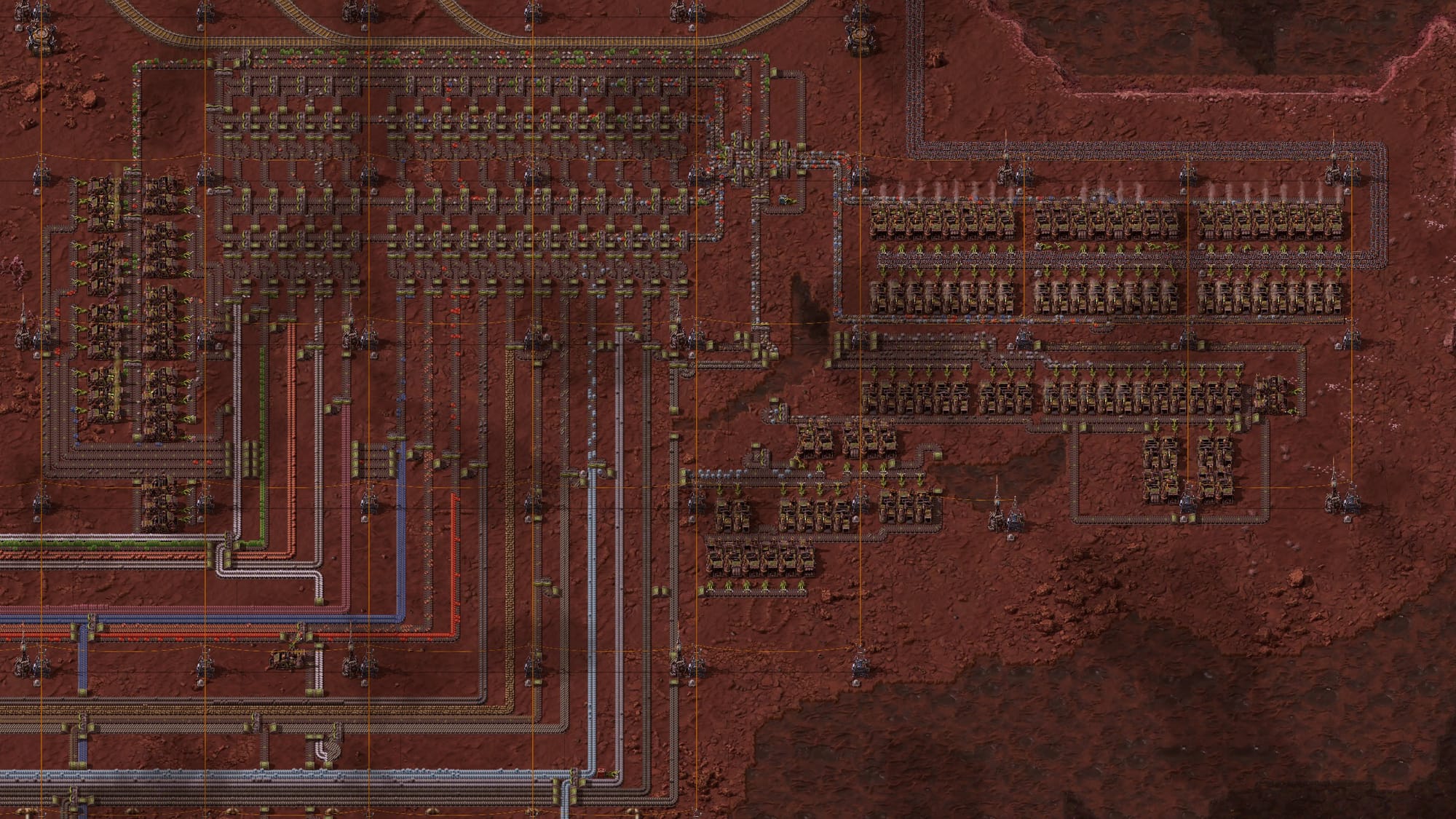
On a second pass, I really enjoyed Fulgora. Seeing the scrap belts eternally turning, automatically sorting and recycling the excess is satisfying once you realize that there really is no resource shortage here. Scrap mines are huge, so don't fret over lost resources. The factory is the priority, and the factory needs more holmium ore. Oh that's right, I forgot to mention that we're here to make electromagnetic science which requires a new resource called holmium. It has the lowest chance of being recycled out of scrap, so really the whole recycling plant needs to be scaled to meet the holmium ore demands. Other than the science, it's used for some cool stuff like Tesla turrets and the very powerful electromagnetic plant.
Gleba
A vibrant multi-colored swampy landscape shrouded in a light mist. The air is thick and humid, carrying the muffled cries of unseen animals from far away.
The first couple hours of Gleba are a complete mind-fuck. The planet is a culmination of everything you should've learned via space platforms, Vulcanus, and Fulgora. Gleba does take it a step further though and force the player into the uncomfortable unknown. Gleba differentiates itself with its emphasis on perpetual motion through the spoilage mechanic. On a space platform if you didn't have your asteroid collection and filtering system down, things would stall out and jam up. If this happened, you'd have to intervene and tweak the system to get things moving again. Here on Gleba, the punishment for stagnation is more severe, nearly every item in the production chain is biological and therefore has a spoilage timer that when reached turns said item into spoilage. It feels even harsher because there appears to be this time pressure component that was typically absent from base-game Factorio. I believe that's one of Factorio's strengths actually, it's laid back, learn and build at your own pace vibe. So, Gleba, on the surface, seems to fly in the face of that. But what's critical to learn here is that, like Fulgora, you have to stop thinking there's a resource shortage. Gleba takes it a step further even, where its resources patches are literally infinite. Although that doesn't mean you can't mismanage them and lose the resource patch.
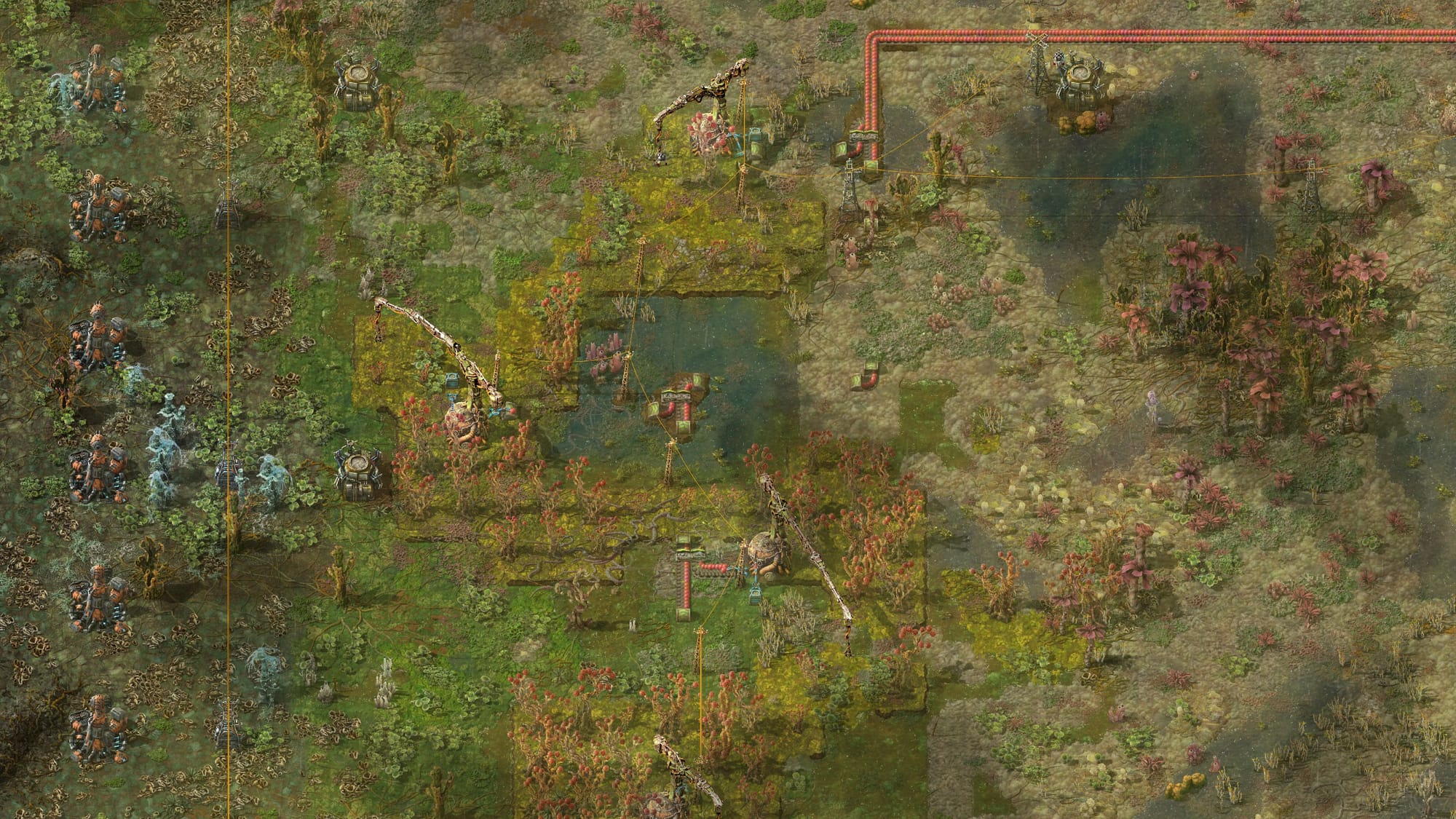
The early stages of Gleba are a bit awkward as development can't unfold as it traditionally would on other planets. The trial-and-error component of learning a new thing in Factorio typically doesn't have any permanent punishment for failure but on Gleba, it's different. Here nearly everything you need is derived from two fruits: Yamako and Jellynut. These fruits are harvested from trees until the tree is entirely gone, which at that point you've hopefully processed some of the fruits and gotten back some seeds to start the cycle all over again. My first resource patches I completely botched by harvesting way too much without saving enough seeds to replant and grow more plants. It wasn't a huge deal though because the little test factory I setup wasn't much of a commitment. I decided to take my losses and find some bigger patches of fertile soil.
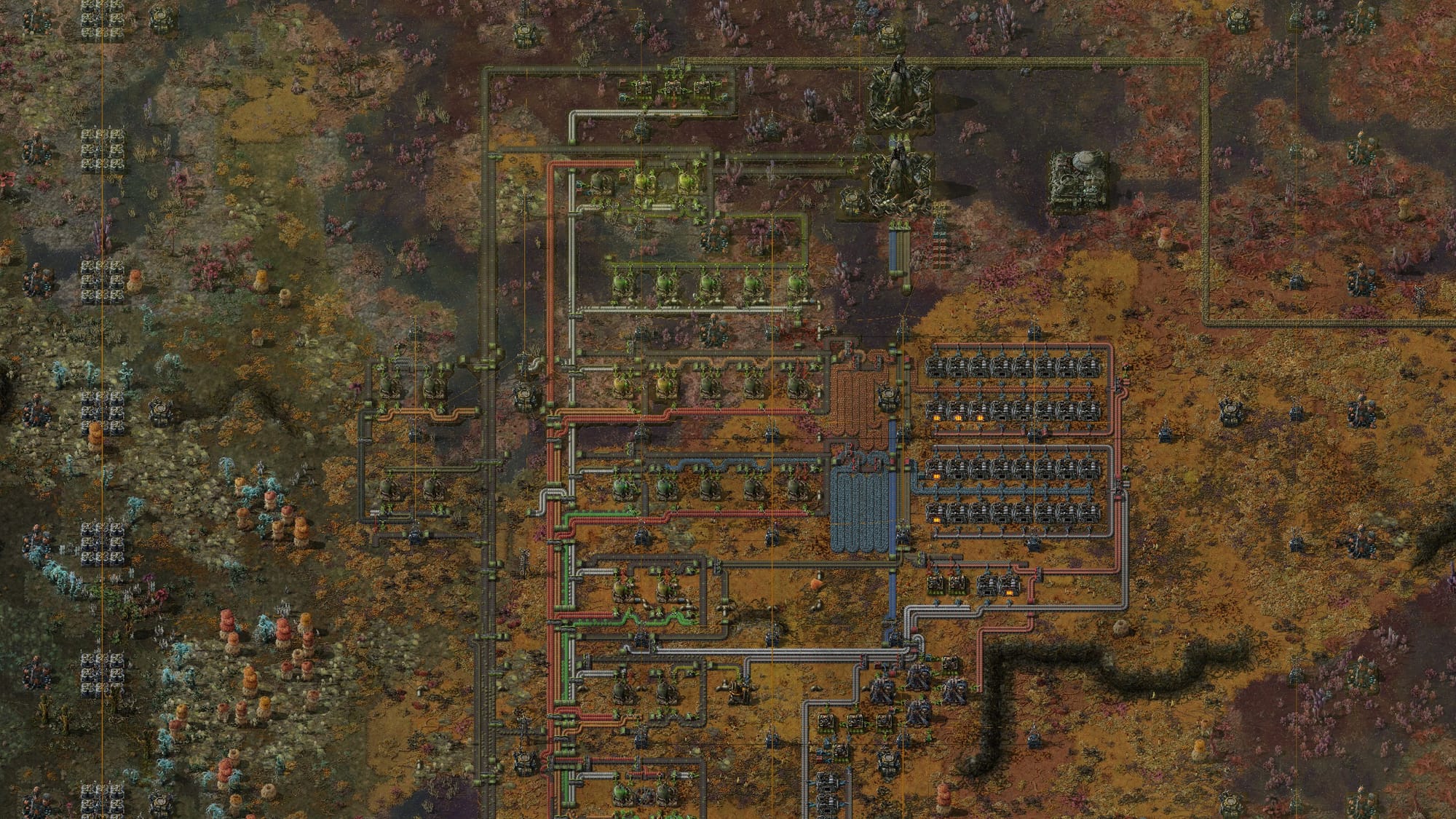
After figuring out the harvesting of the base resources, building out a full-scale factory was quite fun. Really, all it took to get there was setting up that proper loop of harvesting the fruit to replanting the seeds to realize spoilage is no big deal. No big deal as long as you never let it back you up. And that leads into the other key point: always have a way to remove the spoilage. This in practice means that every belt line or loop that has biological material on it needs to have some way of offloading spoilage. In my final version here, I had a dedicated belt that would send all spoilage to be incinerated for power by my heating towers. That meant all of my other lines had to have some sort of outlet in the form of splitters or inserters that would filter out spoilage and put it on this disposal line, thus keeping everything moving.
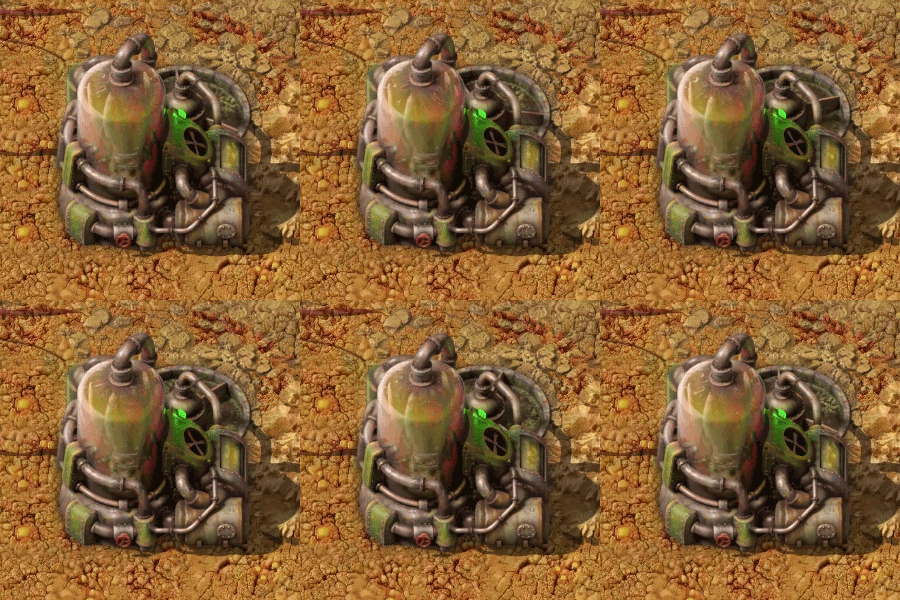
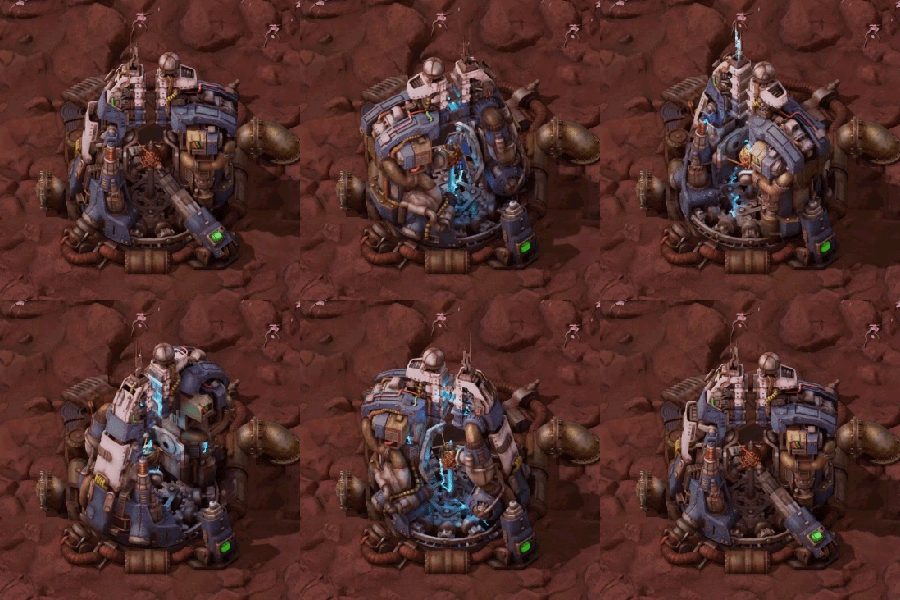
This may seem like no big deal, but the devs knew what they were doing when they decided the new Biochamber needed to be powered by nutrients, a biological item that spoils. This nuance adds a ton of wrinkles to how you need to build out your Gleba factory. The more ingredients that can spoil, the more opportunities for lines to backup, meaning the more opportunities for spoilage to appear. But like I learned on Fulgora, I love belts, so doing all that belt weaving, splitting, filtering shenanigans is just what I'm looking for. Another fun biological hazard is that the biological science packs require pentapod eggs. Oh yeah, there's new enemies here on Gleba, and of course we're stealing their eggs and using them to research rocket turrets to wipe them out. The "fun" part about pentapod eggs is that they too "spoil" just this time it's into real, live pentapods. So yeah, that's why I have Telsa turrets posted up in the middle of my science production area.
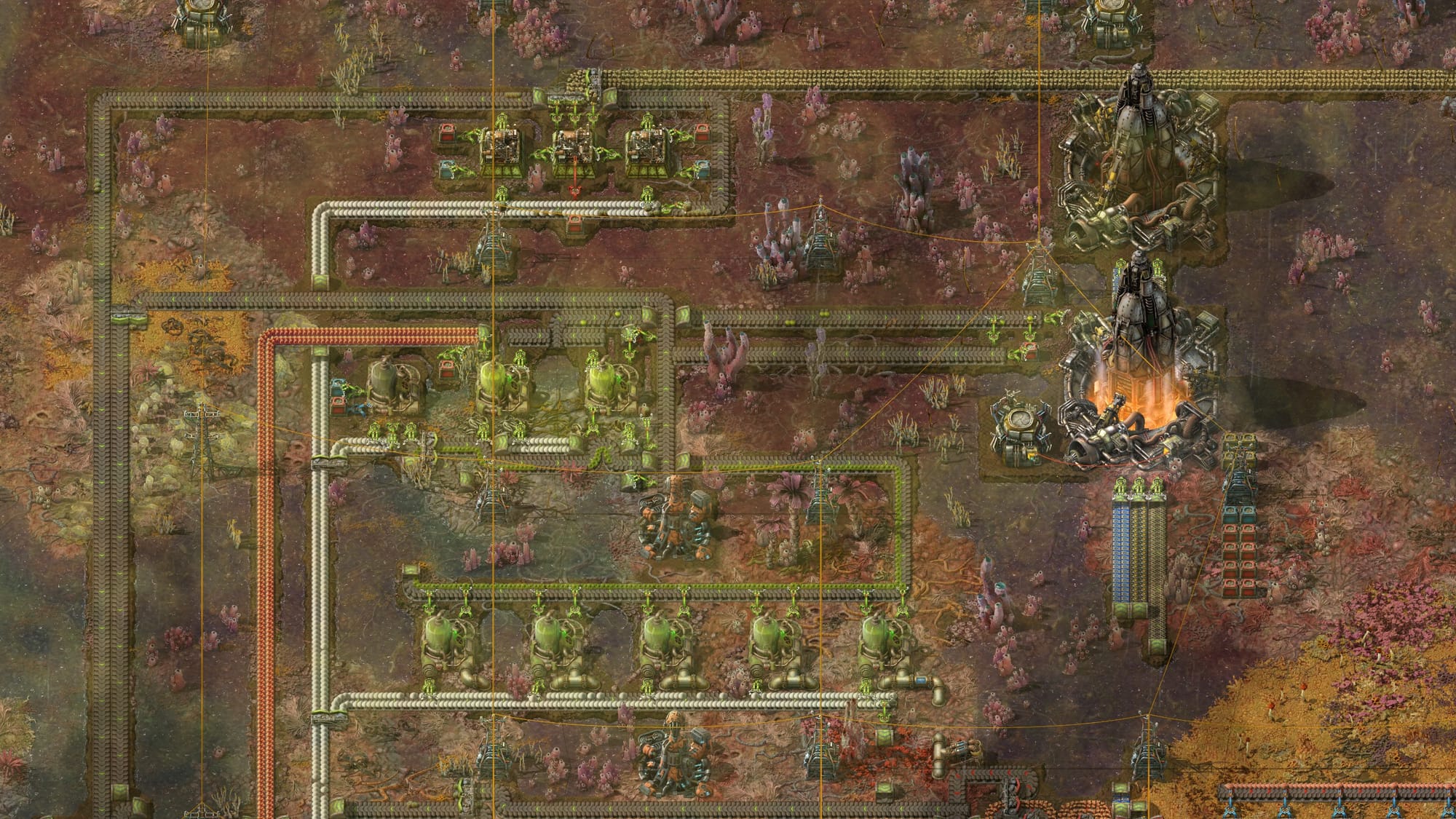
Overall, after a rough, initial learning curve, Gleba turned out to be a lot of fun. This might be the planet I'd like to return to the most and do a Fulgora-style overhaul, although I'm much more satisfied with my first attempt here on Gleba. Next up Aquilo and there's only a few asteroids that stand in our way.
Aquilo
It's day, but stars still twinkle in the dark sky. You count the planet's sun among the stars, larger and brighter than the others, but still so distant you can barely feel its warmth at all. A howling wind chills you to the bone and gently rocks the iceberg you are sitting on.
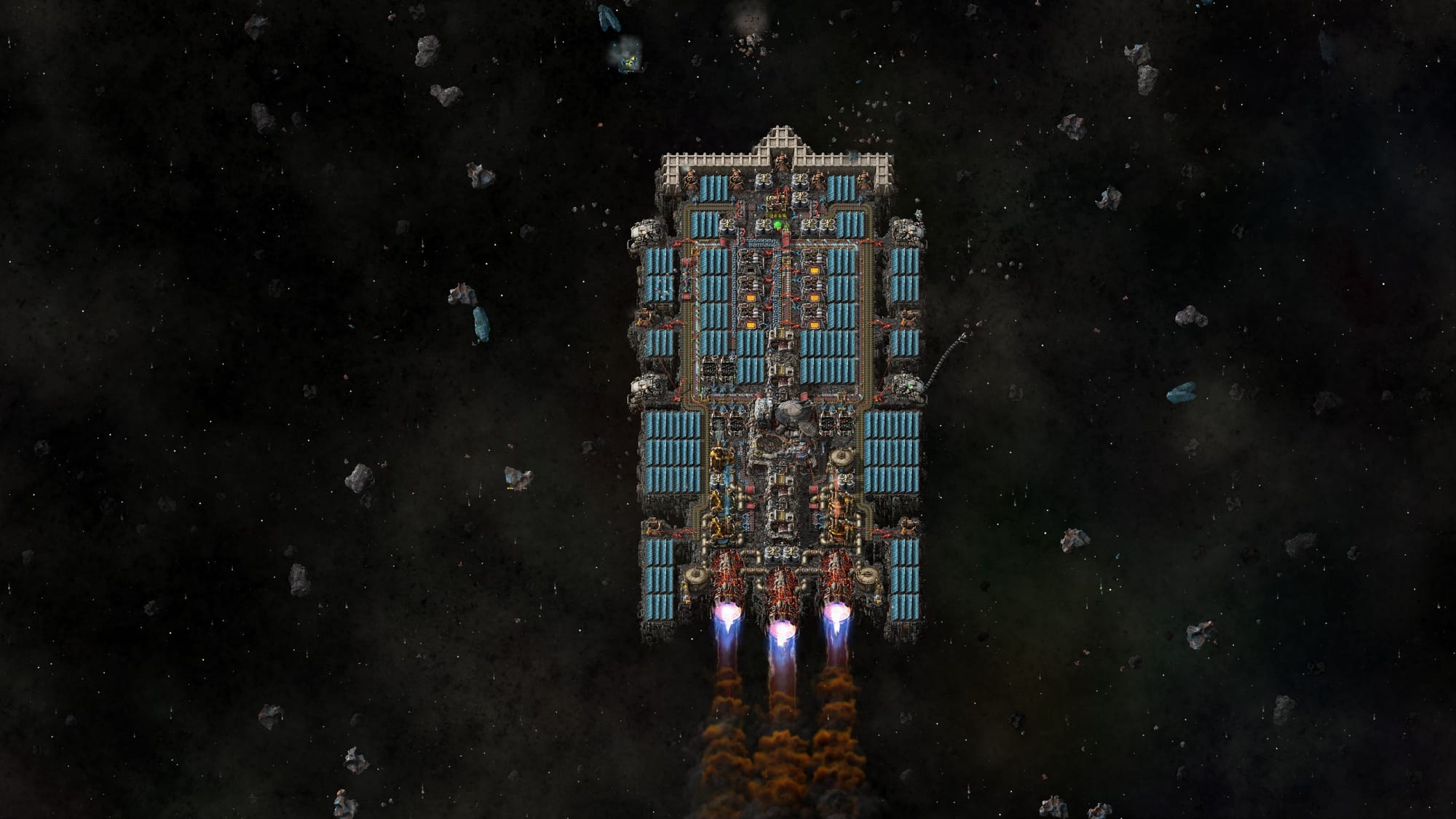
So far, flying between Nauvis, Vulcanus, Fulgora, and Gleba had been pretty straight forward. The starter ship I built for the route between Nauvis and Vulcanus I was able to copy and paste for my other trips to the newer planets. Some modifications were made along the way, properly optimized thrusters feeding them with fuel on a timer, tweaked numbers and positions of turrets to mitigate some chip damage we were taking on alternate routes, plus tacking on a couple more solar panels to help in the darker parts of the solar system. At the end of the day though, the base model handled all of the inner planet, interplanetary trade routes really well. However, traveling to Aquilo was a different beast for a couple reasons, let's get into it.
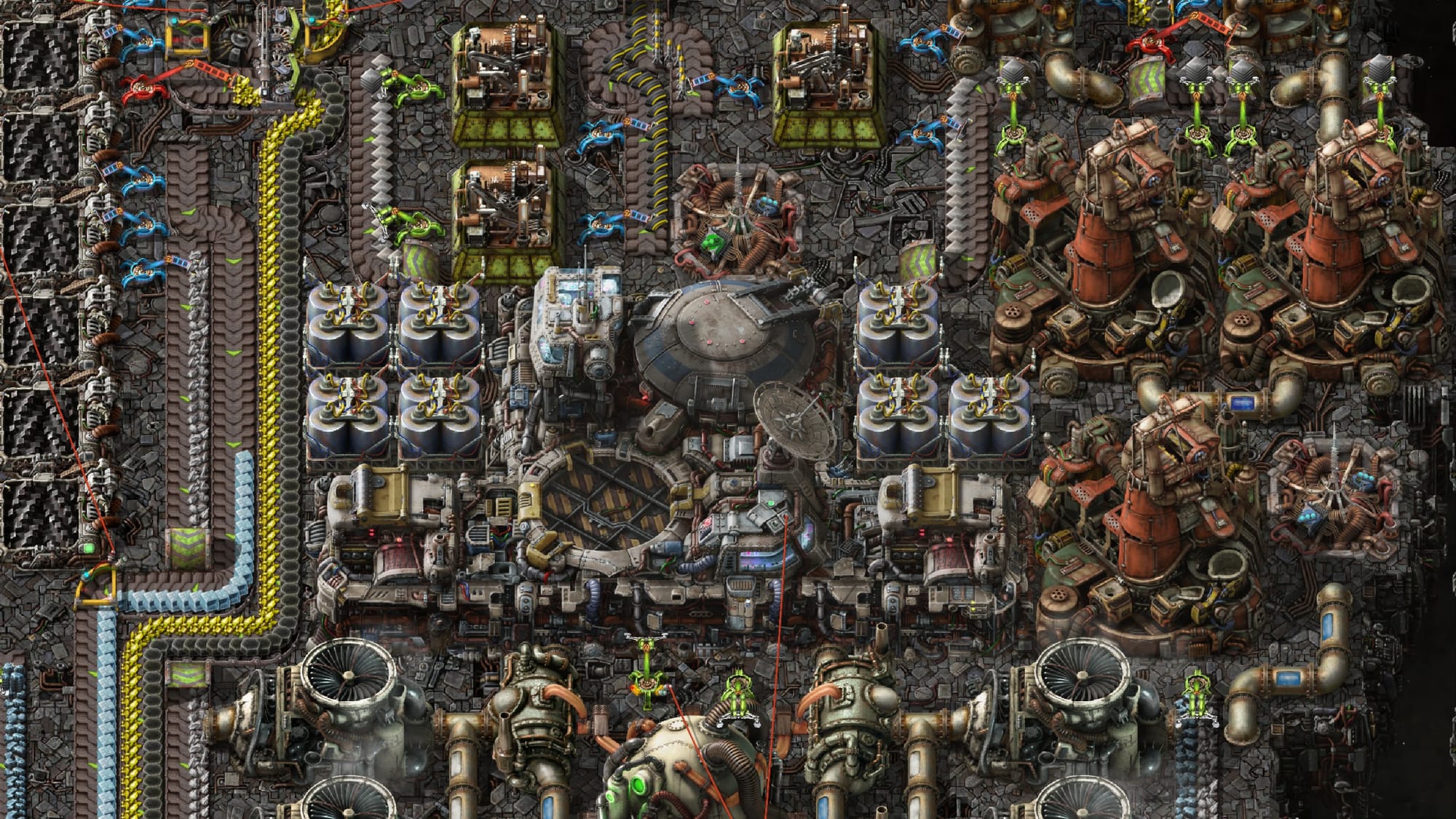
First and foremost, the edges of the solar system are dark and therefore solar panels become extremely ineffective and thus power must come from elsewhere. The clear winner in this department at this point in the game is the nuclear route. While you can't harvest uranium asteroids, you can just stock your cargo bay with hundreds of fuel cells and never worry about power again. So, this is what I did for my Aquilo ship. Honestly, the harder part that I hadn't initially considered was the water requirements for this power source, but we'll get to that in a minute. The second big change is the asteroids. Gone are the days of little asteroids dinking your ships and knocking out a single turret. On the route to Aquilo, huge asteroids, the size of cargo bays, can sideswipe your ship and take out a whole section crippling it to the point it stalls out mid-flight. You really have to take these huge asteroids seriously and by seriously, I mean with rocket turrets, little armor-piercing bullets aren't going to help here anymore.
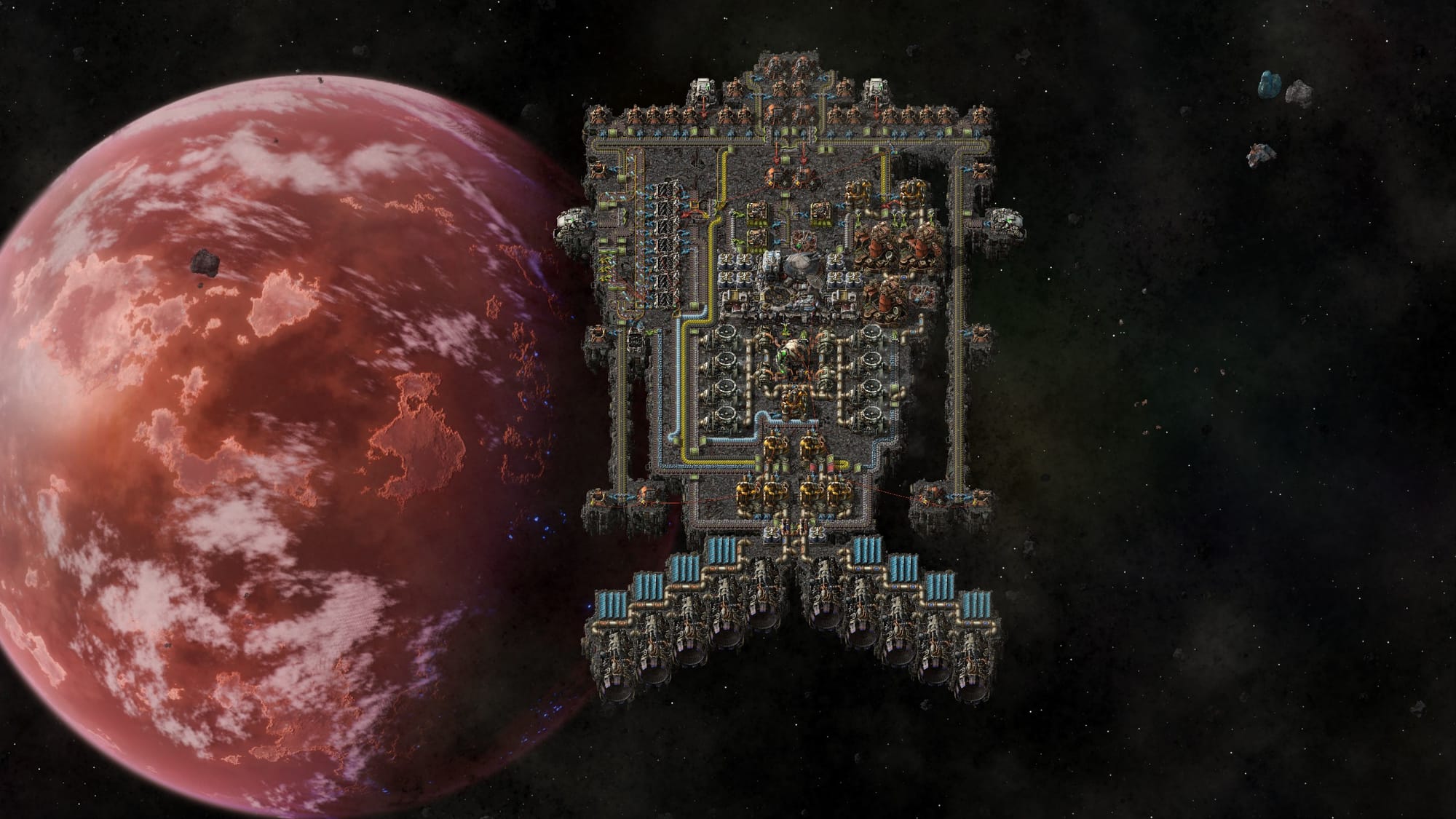
With those considerations in mind, this is the ship design I ended on. It took quite a few failed trips to Aquilo, a lot of guess work, and a ton of little tweaks. Ship design is honestly one of the trickiest aspects of the game. It's very open-ended. You start with a blank slate, and everything you need must be launched into space before you can use it. In particular, I find it difficult to assess the requirements for a ship build without some guess work and doing trials. Take delivering science to Nauvis as an example. How much science should I pack into the cargo bays? How long will it take round trip from planet A to planet B? How fast is my ship going to travel? How do I control how fast my ship travels? These questions are probably answerable, but it's not as easy and intuitive as checking the assemblers output rate and looking at the belt throughput rate. At the end of the day, the ship designs are cool, watching them in transit is mesmerizing, it's just the building part that I find unintuitive and a little frustrating.
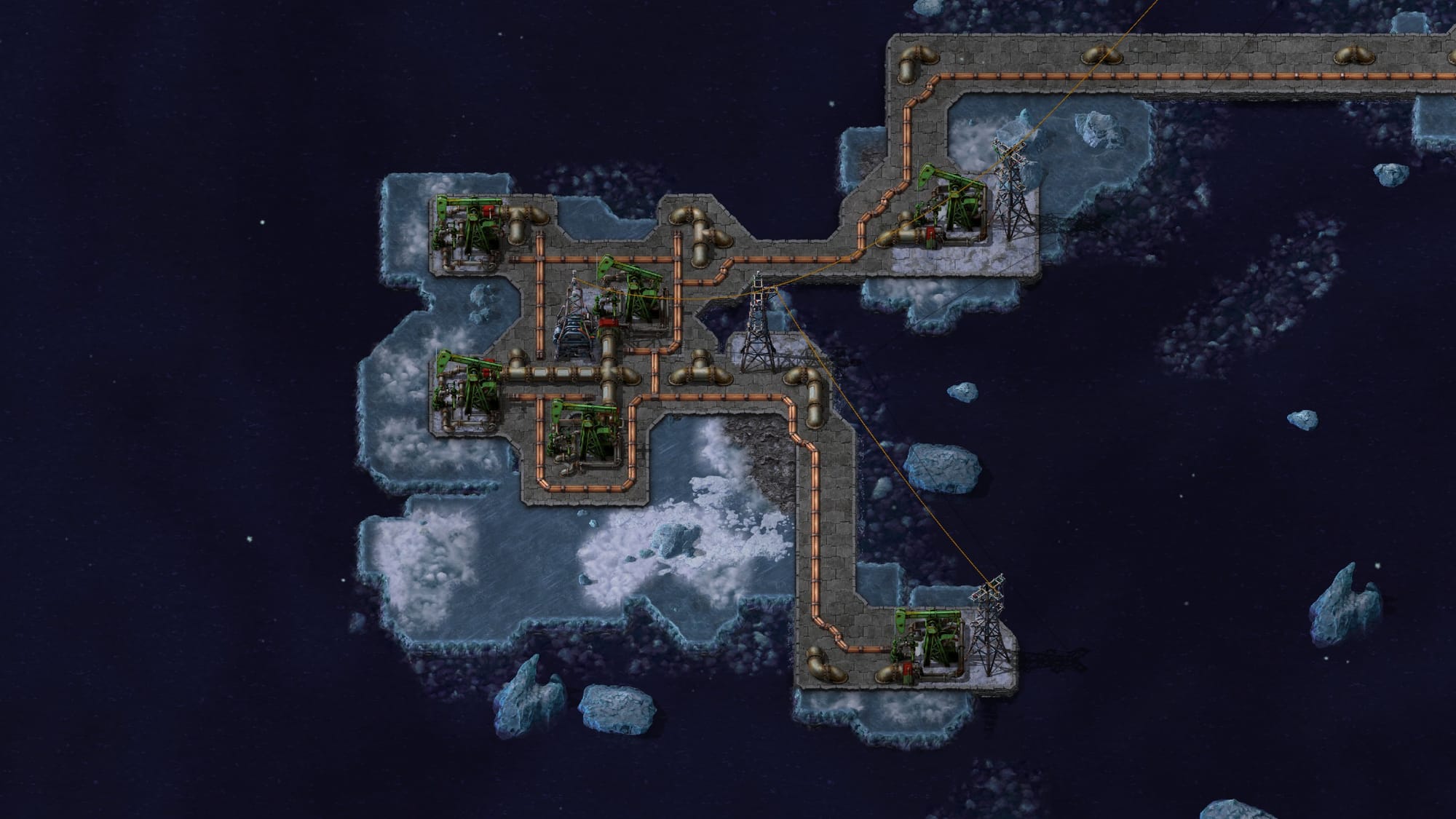
But what about Aquilo itself? Well, it's cold, really cold. To the point that nearly everything needs to be heated for it to function. This is the central concept of Aquilo that fundamentally changes how you build out your factory. Heating pipes must be adjacent to belts, inserters, pipes, assemblers, otherwise they freeze and cease working. Once again your familiar designs must be torn up to accommodate this new design constraint. And while it's more of a simplistic constraint, have fun designing a tile-able design for the six input, two output quantum processor item...holy smokes.
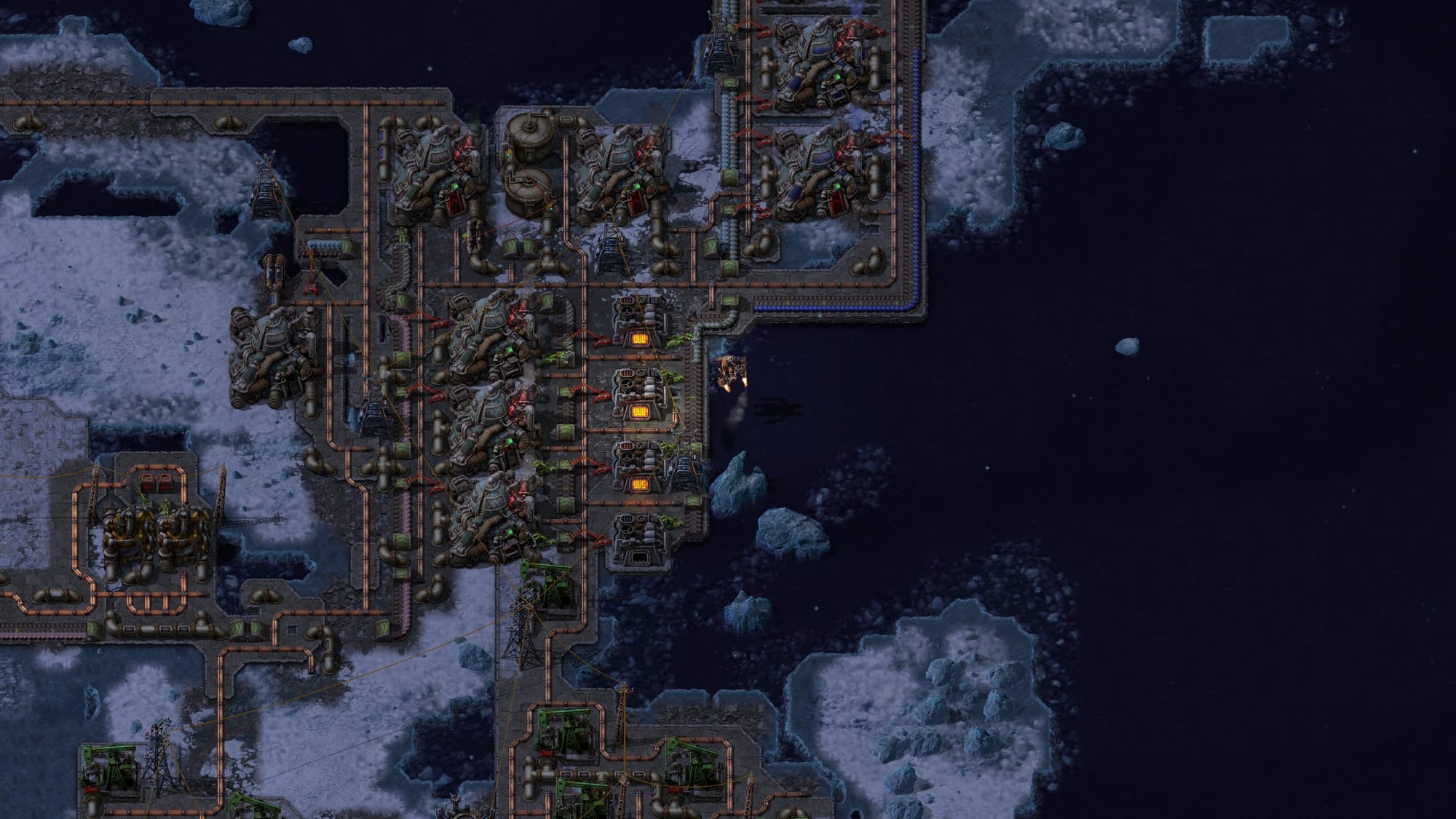
While heating pipes certainly change how you build, the raw resources of Aquilo fundamentally change what you can and can't do on the planet. On the previous planets, it may have been more convoluted, but you were always able to find your way into crafting the base necessities: iron/copper plates and crude oil. On Aquilo, the expectation is dependency on other planets. Again, on previous planets, the research tree to that planet's science pack laid an on-boarding path for the player to learn new mechanics, recipes, items, etc. But now on Aquilo, the path has several steps that require items from other planets. So in my mind it's clear that the developers wanted players at this point to have to fully engage with the interplanetary logistics system.
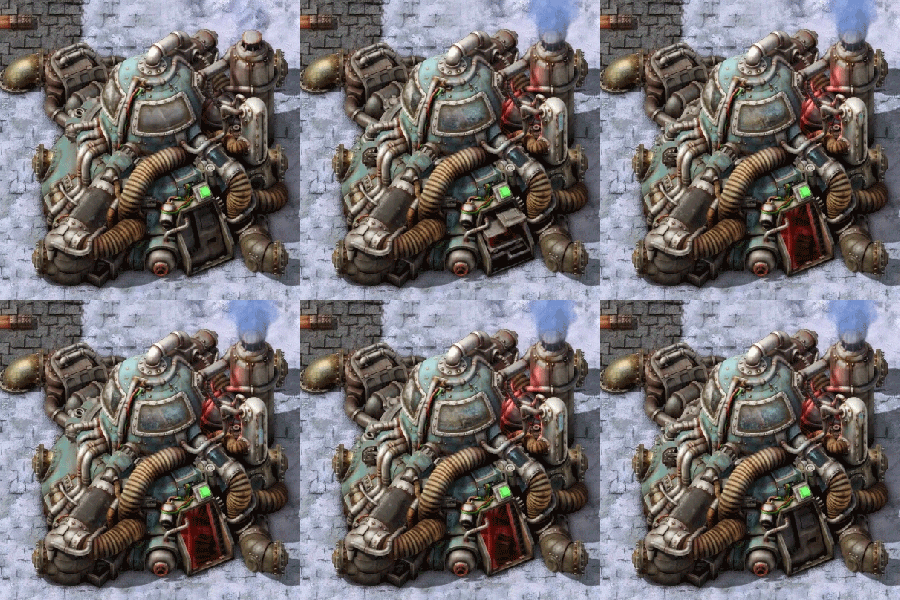
While there is more to Space Age and, in general, there's always more Factorio has to offer, my Space Age playthrough crawled to a halt as burnout set in and a forearm injury made using a mouse unbearable. I had the drive to finish out as much as I could but nerve pain is no joke. I tried out using a controller and, despite its really nice support and features, 500 hrs of mouse and keyboard muscle memory made the transition more unbearable than the nerve pain. So, at the end of the day my Aquilo base limped across the finish line, accomplishing the bare minimum, cryogenic science at 60 spm. The Aquilo ship brought in the rocket silo materials and then continuously supplied the rocket part materials too. There's definitely more to do on Aquilo, but for now this is good enough. Oh and the finish line I mentioned, it was completing all non-infinite research technologies. So yes, I did unlock the ridiculously cool railgun and no I didn't get to put it to good use yet...
Quality and Elevated rails
The two other noteworthy additions Space Age made were Quality and Elevated Rails. I left both to this last segment because I felt like neither found their full potential in this playthrough. Starting with Quality, it's a system where items can be crafted into a higher rarity version. The higher rarity versions have improved stats, added bonuses, etc. The method for generating higher rarity items is a game of percentages. When you insert a quality module into machinery, that machinery gains a percentage chance to create an item of higher rarity relative to the rarity of the crafting components. In combination with recyclers, you can create production loops that craft, sort, recycle, and save high quality items and recycle low quality items. It's a neat little puzzle, that can become a massive puzzle if you're interested. In this playthrough, I did not venture down this path and really only made a few space platform components with higher quality. The appeal didn't exactly click with me, but Fulgora certainly feels like an interesting planet to undertake a massive quality-recycling project.
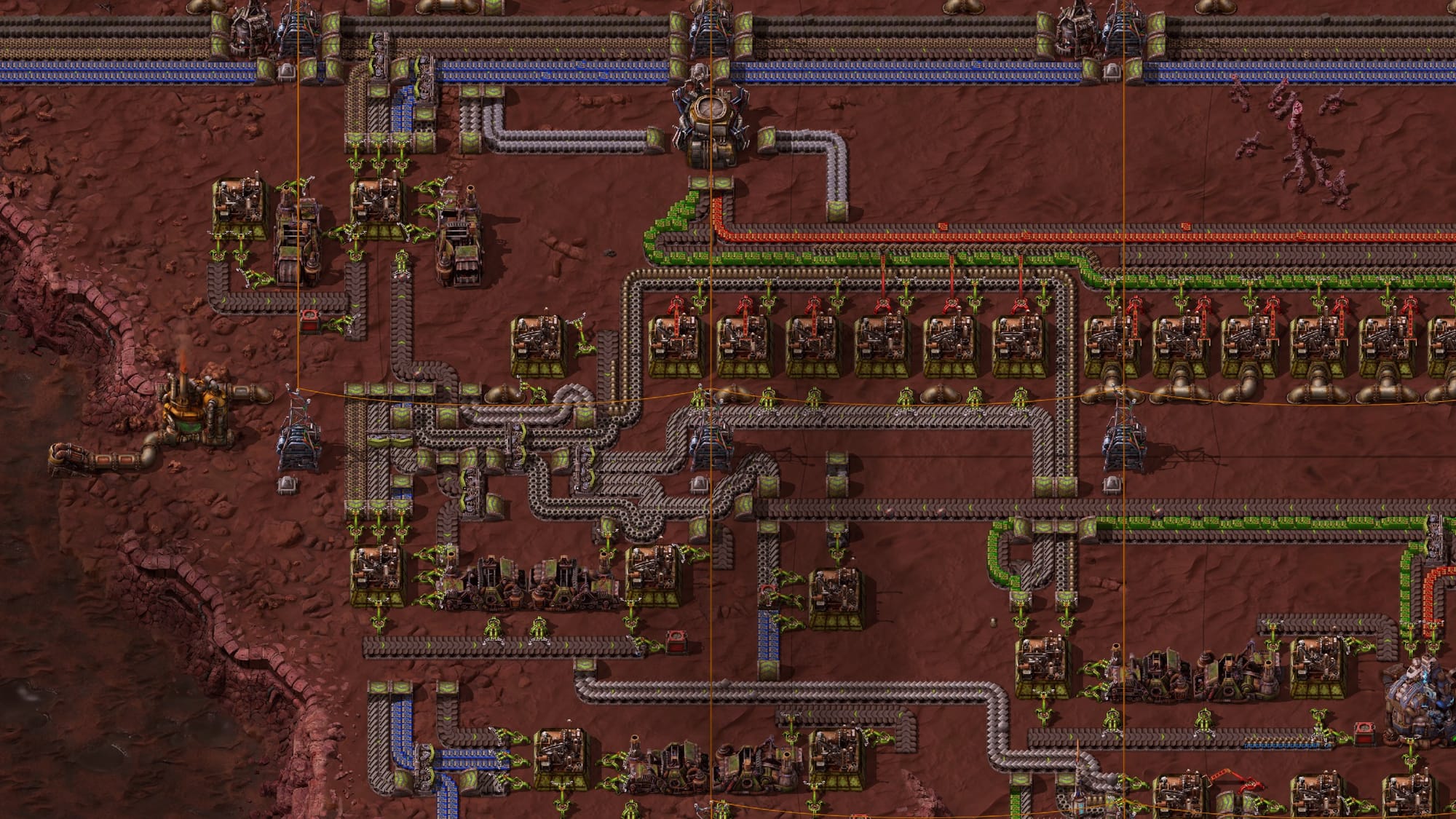
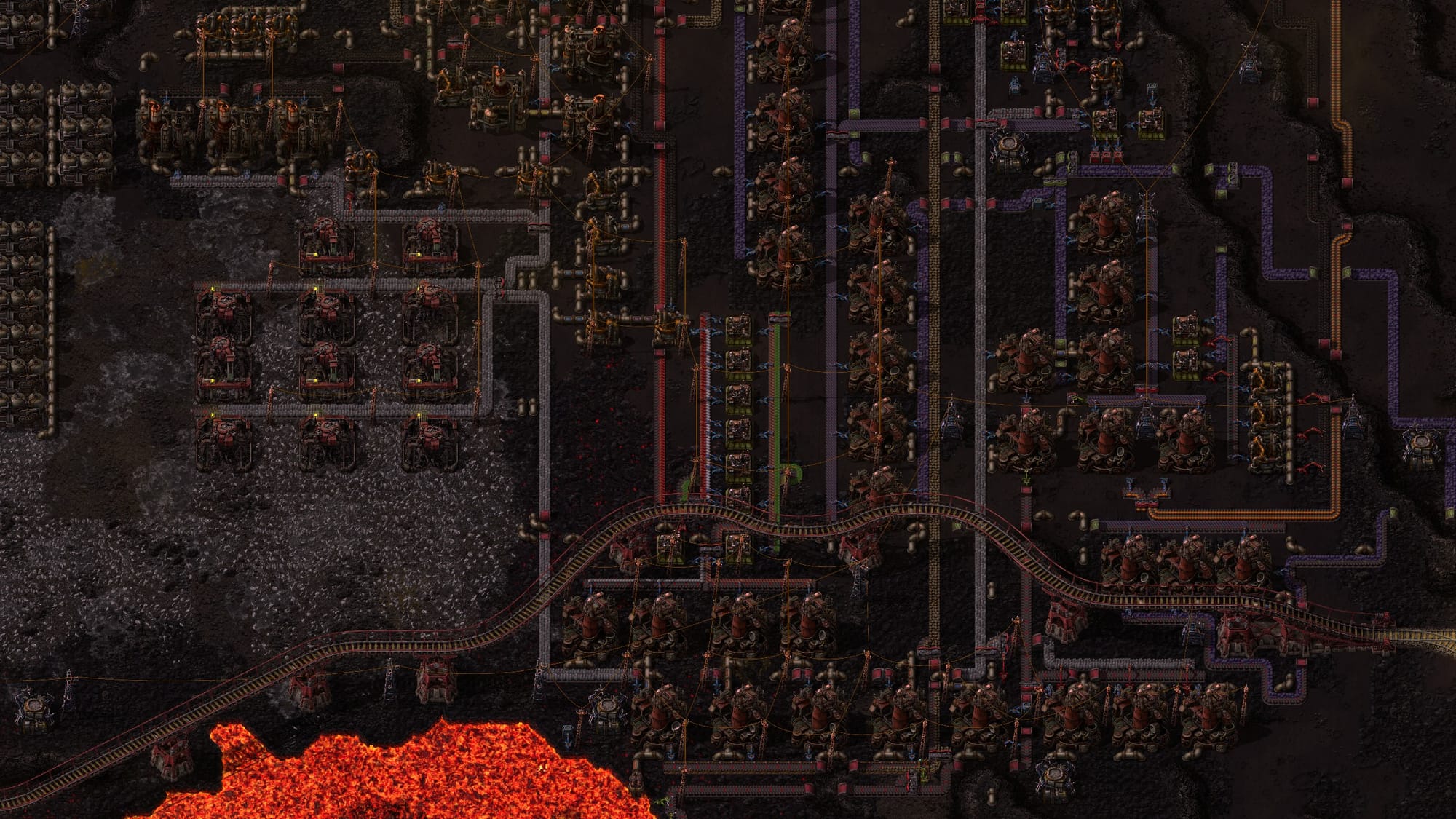
The other addition, Elevated Rails, again I only interfaced with a little bit and only out of necessity. On Vulcanus it's a very nice option to have and on Fulgora it's all but necessary. Right now, all I can say is that these things are cool. Part of the reason I just want to hang out on Nauvis and build a huge train network is because figuring out a dense, multi-level rail system would be super cool. Seeing huge trains slither their way around is a rather large part of my enjoyment of Factorio, and this addition only enhances that aspect of the game.
The Montage
I've had trouble finding time to record narration and seeing as how I've written plenty about Space Age, I opted to make a quick montage of my Space Age playthrough. It's nothing special, but it is my first shot at this behemoth of a game. It'll be fun to look back down the road when I've perhaps put another few playthroughs under my belt.
Verdict
★★★★⯪
Space Age is a phenomenal expansion for a legendary game. It takes core concepts of the base game and turns them on their heads in an incredibly fun manner. Each new planet presents a new Factorio-style puzzle that forces the player out of their comfort zones and into a new frontier. The art of Space Age is what originally grabbed me before I even played the base game. Now after playing through most of what the base game and expansion has to offer, I can confidently say the top-tier factory-building and automation gameplay is matched in quality by its art design counterpart. Outstanding work bringing life and a clear style to the factory-building/automation genre, a genre that is often rather stale.
Now is Space Age as perfect as base-game Factorio? Not quite. Base game Factorio is such a sleek and smooth-running engine that nothing quite compares. For Space Age, I think each planet as a standalone experience is exceptional. Like I said, I had a lot of fun with each of those planet-scale puzzles. What falls a little flat for me is the space platforms and interplanetary stuff. Designing platforms is oddly open-ended and hard to understand. And while setting up interplanetary trade routes is just as easy as the train networking system, it's less visually satisfying as it's all hidden away behind menus. Quality also fell flat for me. It's essentially a puzzle I didn't fully dive into on my first playthrough, so tough to rate it, but it does end up feeling tacked on to me. To sum up my thoughts, I loved my time with Space Age but would recommend newcomers start with just the base game. For Factorio, I'm still a newcomer, so in future runs I might just stay on Nauvis and build huge train networks.